-
What's your major?
This quiz will tell you.Take Quiz Pinterest: #CreativeCover 2013
- The MyMajors Network:
Creative Outlook
Transfer Guide
Counselors Guide
High School Interns:
Annamarie
Braxton
Lauren
Madalyn
Nikki
College Interns:
Ariana
Ashley
Erich
Grace
Rachel
Expert Advice:
For Students
For Counselors Archives
@MyMajors on Twitter
Error: Twitter did not respond. Please wait a few minutes and refresh this page.
Author Archives: Aaron
Creative Outlook Contest Update!
*As of April 24th, 2013
The Creative Outlook Cover Contest has taken off and all our students are seriously GOOD!
I am far from being a talented artist (err yet an artist period), but I’m amazed at the amount of talent of these students.
Quick look at submissions so far through 24 days:
- 189 Entries (see entries)
- 2,402 Votes
- Top Voted Artwork as of April 24, 2013:
- 24,328 Pageviews
- 160,000 Emails Sent
- 9 Art Teacher of the Year Nominees
Keep up the good work students and art teachers! Last year we had over 900 submissions, can we beat it!?!?!?!?
Please share the contest with friends and family and if you already submitted don’t forget to share to get more votes! Which one is your FAVORITE??? Vote for it and comment below!
Follow us @creativeartmag on twitter or visit www.creative-outlook.com to see all submissions.
New York Times Online Article Featuring MyMajors – “Major Decisions”
Cecilia Capuzzi Simon wrote a great piece in the New York Times about the decisions students should make when it comes to choosing a major.
Read the NYtimes.com article here
I, for one, am glad this topic continues to be discussed. It amazes me that college and career readiness for high school and college students seems to be a low or “not a priority” because “getting in” to your college is where most students and parents focus their efforts.
The all important question does get asked, “What’s your major?” but really there is a bigger picture that many students, counselors and parents miss – the lack of an academic and career plan can increase student debt, create the wrong career path, and attend a school that does not fit the student’s personal goals.
Here are a few key points that caught my attention from the New York Times article:
- “At Penn State, 80 percent of freshmen — even those who have declared a major — say they are uncertain about their major, and half will change their minds after they declare, sometimes more than once.”
- “Students no longer have the luxury of stumbling into a major or making mistakes,” says Neeta P. Fogg, a research professor at Drexel University’s Center for Labor Markets and Policy,
- “You’ve taken the same six subjects since kindergarten. If you don’t know your major, don’t come here and take the same subjects expecting to figure it out.*” Mary Beth Collier, the dean of academic advising at the State University of New York at New Paltz
- “We tell students, ‘Find a major that makes you intellectually engaged, that expands your brain and deepens your understanding of the world.’”
- “Some majors have a curriculum that follows a tight sequence of courses. It’s easier to switch out of engineering than it is to take it up (if that’s possible at all) later in your college career.” Dr. Fritz Grupe, the creator of MyMajors.com and an emeritus professor of computer science at the University of Nevada
- “Students often don’t realize that many popular majors — psychology, social sciences, business — have math and science requirements. You might have to forgo majoring in economics, for example, if come junior year you have to make up courses in calculus and statistics.” Dr. Grupe
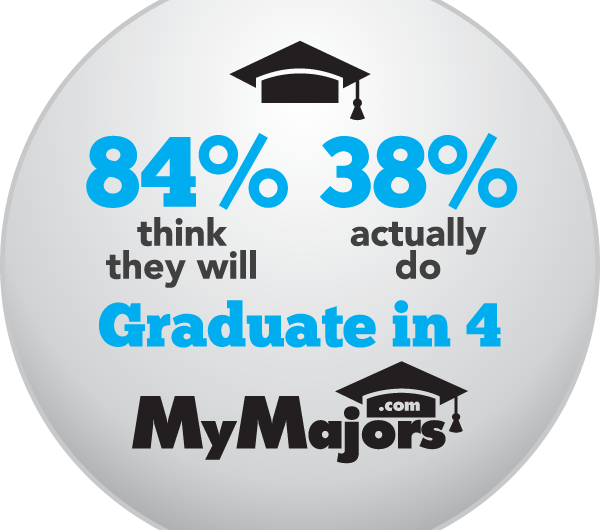
We all procrastinate what we want to do with our lives and say we will figure it out later. But procrastination is expensive! A great point that is included is that students sometimes think what they want to do now will get them a job after they graduate. The job market is volatile and jobs that are needed today, might be on the sharp decline in 4 years (that is…if you are in the 40% that actually graduate college within 4 years). Being actively engaged with your goals and having a plan at all times will help prepare for changes in the market.
Educators need to get information in front of students and students need help at focusing their ideas and plans. This doesn’t mean being stuck in one major the rest of your life, but have a few options for your career path and a backup plan, because as the Penn State study shows … over half of students will switch their major at least once!
“The future depends on what you do today.”
― Mahatma Gandhi
What are your tips to finding the right major?
Posted in Other
Leave a comment
Find your Major, College and Career
with MyMajors – Video Tutorial
Have you found your Major, College or Career yet? This video will walk you through how you can create your plan in less than 15 minutes.
MyMajors is a unique resource that helps students create their own customized pathway to finding their Major, College and Career. This video will show you what to expect after completing the quiz, all the resources on the site and how to use your results to create a plan for college.
If you already took the quiz but missed out on all these features you can login, or start over here.
If you have any questions email info@mymajors.com, or post a comment below. If there are any other tips or videos you would like to see let us know!
MyMajors Team
Post Your Majors @MyMajors #whatsyourmajor
Tweet your top majors to @MyMajors and don’t forget to hashtag #whatsyourmajor
So you think you have the best major? Do you want to scream it from the mountain tops or for most people today…scream it from the mountain tops with an @ and hashtag.
I mean one of the biggest pickup lines is still:
“Hey…so…what’s your major?”. If you haven’t heard someone say that or you haven’t ever said this, then I would guess you are lying to yourself!
So why not beat them to the punch! Tweet to your friends and followers. Use this button, or tweet out #whatsyourmajor and your recommendations. It would be bonus if you gave us a shout out as well. Try it out now:
My tweet:
“Accounting, MIS, Healthcare, Finance, Entrepreneurship…my top Majors @mymajors #whatsyourmajor”

Follow us @MyMajors for other related collegey things, some free stuff and scholarship opps every now.
Until next time…
The MyMajors Team
#superherowannabes
Posted in Aaron, Frequently Asked Questions
Tagged #winning, FAQ, MyMajors, Results, Twitter
Leave a comment
MyMajors Student Profile Pages
NEW Profile pages: Login in a new window to walk through the process: http://www.mymajors.com/login_form.cfm
After a student completes the MyMajors Assessment they will receive their top 5 majors, also called the My Majors tab:
My Tabs are resources to help the student find their:
1) Major
2) School
3) Career
4) Advisement Report
5) Account Info
6) Financial Aid Info.
The #1 recommended major is listed as “This is MyMajor”. Students’ can click on “Make MyMajor” to the left of #2-5 ranked Majors, which will make that Major their #1 Major. You can click on the Major name to go to the specific Major Page. The School Matches box (in red) will show Schools that offer that Major. If you do not like any of the Majors recommended, click the black “X” button on the right, and a new major will populate.
Now that you have your #1 Major, let’s find a School, click the “My Schools” tab!

On the left search tool, your #1 major will be listed and any specific state that you set up in your preferences during the assessment. You can make any changes to the search, just make sure to click “Submit” at the bottom.
The Schools will now be shown that offer the degree program (or a program equivalent to your search). Click on the school name to go to their School Page. The “Match Me” button on the right is an easy way to connect with that school if you want more information and think this could be your future school.
Next up is the “My Careers” tab:
The five columns are your top 5 Majors. Below each Major are a list of top Careers that match your specific Major. Keep in mind these are examples of good fit careers, but you may be better suited for different career within this academic field. You can click on each Career to go to that Career Page for more detailed information including descriptions, activities, abilities, knowledge, work values and styles, salary, and Holland Code Chart.
Next tab is “My Report”, which includes your Advisement Report:
The Advisement Report lists your top 10 recommended majors and a comprehensive list of all your answers to the MyMajors Assessment. If you have an access code, click the “I have an access code”, and enter your code in the next window. Your Advisement Report will then open. If you do not have an access code you can like us on Facebook or +1 us.
Under the My Account tab you can Re-Take the Assessment, edit your personal profile or edit/review all your answers during the assessment.
My Finances tab includes an opportunity to find student loans through SimpleTuition and information about different types of financial aid. Login now to see your results!
Check back in later for more information and new features we are adding to the site every day! Our goal is to make your college and career readiness easier and create a plan for the future.
- The MyMajors Team
Posted in Counselor's Corner, Frequently Asked Questions
Tagged Academic Advising, Counselors, FAQ, MyMajors Quiz
Leave a comment
The Right Success Starts with the Right Advice
Quality Student Advising at the Heart of a Transfer Student’s Success
Written by Lisa Darnell, Benedictine University, Transfer Coordinator
Discipline, planned advising and fiscal responsibility are
hallmarks of a successful college career. Students are primarily concerned with two things:
How long will it take me to graduate? How much will it cost?
Someone once said that “time is money” and college is certainly no exception. It is important to make the most of hours spent inside and outside of the classroom at community college. Potential transfer students should work with community college advisors and admissions staff at four-year schools to keep educational goals and graduation on track. As a transfer admissions counselor at a private university, I recommend potential transfers focus on the following:
Major woes?
If you can’t decide between business and science, attending a community college is a very cost effective endeavor. The wonderful thing about your early college career is that general education classes can help you explore your interests. It isn’t a bad idea to take a “Business 101” or “Principles of Biology” class to see if the subject material really interests you. Even if you change your mind about a major after taking an introductory class, at least you know now instead of wasting time and money deeper into the program. Also, at the very least the class may transfer as elective credit toward graduation.
Students who require assistance beyond introduction classes to help decide a major should seek out career counseling. Typical services offered are career assessment tests, one-on-one counseling sessions, job shadowing, job fairs, resume and cover letter writing assistance and internship resources. All students, undecided or not, really should utilize what career development offices have to offer because early preparation makes you more competitive once you enter the workforce.
Talk to admissions staff at four-year schools.
It is also advisable to look around at different four-year schools you would consider applying for admission and find out their requirements. Some schools may want specific classes to be completed prior to transfer, while others do not. Once you know the criteria you can find common denominators between schools and take classes that could transfer across the board. Safe, basic classes are usually the required English/writing courses, speech communications and a skills level math like college algebra or finite mathematics.
You will also want to know if the schools you are applying to require you to declare your major right away, and if there are specific admissions requirements housed in different academic colleges. If you have narrowed your search down to one or two schools it is a good plan to tailor your community college education to meet the degree requirements of your future program. Check to see if the admissions staff your prospective schools are willing to provide you with unofficial transfer credit evaluations while you are plugging away at your courses, and to see if they will help you select classes that will transfer. I will typically meet with my potential students one semester to two years in advance to help them plan their time efficiently.
Scholarships.
Most four-year schools may offer merit scholarships to transfer students based on their cumulative transfer GPA. Doing well in your classes can translate directly into money, so be sure to study hard, or retake a class you may not have done as well in to ensure a strong GPA.
Demystifying Financial Aid.
Applying for financial aid through the federal government can be an overwhelming process, especially for first time filers. Some transfer students who attend community colleges opt not to apply for financial aid to help pay for their education because they think it is unnecessary due to the lower costs of attendance. If you have not filed for financial aid in your previous terms or you are considering transferring to a four-year school for the next school year, I offer this advice:
File the FAFSA Early.
Certain types of state and federal aid are on a first come, first serve basis. The Free Application for Federal Student Aid (FAFSA) is available January 1 of every year through the Department of Education’s main website www.FAFSA.gov. Students applying for financial aid for the upcoming fall 2012 term will be filing the 2012-2013 FAFSA using 2011 tax information. If 2011 taxes are not filed yet, it’s not a problem. There is a “will file taxes” option available so you can complete the form with estimated information in the meantime.
There are several different types of financial aid available to students, such as loans, grants and federal work study. Typically applicants qualify for at least federal student loans, while the other forms of aid depend on demonstrated financial need. Once the FAFSA is filed, it provides students with a number referred to as the Expected Family Contribution (EFC) Score. Financial aid offices use this number to determine aid eligibility.
Get accepted!
If you want to compare your out-of-pocket costs between four-year colleges and universities, you need to be admitted first. Your official financial aid package comes after you are accepted and usually with other helpful information to help make a final decision between schools – such as the coveted transfer credit evaluation and your scholarship award letter. Additionally, be sure to add each institution of interest to the FAFSA. •
Posted in Counselor's Corner, Other
1 Comment
When do I select a major?
50% of students go to college without a clear intended major. You can decide on a major anytime you feel it is a good match with your strengths, weaknesses, abilities and future goals.
Many students enter college not knowing what they will major in and many will change their mind once, twice, even more times before they find the right choice. Some universities actually discourage premature selection of major and ask that you wait until the sophomore year to make this choice. On the other hand, many students need an academic plan set their freshmen year, so they can graduate within 4 years. Having a couple majors in mind going into college will only help you get ahead of your college planning – and help you have a backup plan if your first choice isn’t right for you!
For instance, engineering majors specify exactly what you need to take in each semester. Consequently, some courses you take while pursuing other majors may not count toward your final major, thereby extending the time and cost of completing your education. At 25,000 a year in tuition and fees, this can be a costly waste of time! If you have thoughts about which major you would like, start taking courses in that field to try out your hunch. It may confirm your feelings or it may convince you that this field is a mistake for you. Almost all majors have sequences of courses in which some courses are prerequisites for others. Delaying too long, may make it impossible to graduate on time.
Some people – high school counselors, your parents, university-wide academic advisors, for example, are completely neutral in their recommendations. Others, faculty in a discipline or advisors for a particular college within a university may consciously or unconsciously, try to encourage you to consider a major because it benefits they department or college to have more majors, rather than that it is best for you. Contact these people when you have already decided to consider their programs.
If you already know your major prior to going to college, make sure the evaluate the colleges academic strength in that major and even job placement. If you want to graduate from XYZ university, make sure they have a great program and you can get a job after graduation!
Good luck!
You can find your major, college, and career on MyMajors. Use the career page to help write a resume with the skills and abilities section.
Take the MyMajors Quiz to find your major – http://www.mymajors.com/college-major-quiz.cfml
Posted in Frequently Asked Questions
Tagged Academic Advising, College Major Quiz, Counselor, FAQ, Undeclared
Leave a comment
Building Your Portfolio | A Quick Resource for Students
A Quick Resource for Students
Submission Courtesy: Savannah College of Art and Design
Use this guide as a resource for building a portfolio or improving one you’ve already started. Keep in mind that guidelines may vary among different schools and it is important that you tailor your portfolio to each school.
A portfolio is a collection of your strongest artistic work that is presented as professionally as possible and demonstrates your talent.
Tips for Building a Strong Portfolio:
• Create artwork early and often.
• Keep a sketchbook or journal to build your creative ideas.
• Take art classes.
• Seek portfolio feedback from peers, teachers, professionals and college representatives.
• Use only original work—don’t borrow images.
• Whenever possible, work from direct observation.
• Experiment with different media and techniques.
• Be prolific; this will give you options later and allow you to be selective when compiling the final portfolio.
Things to Consider
When choosing the works that will represent you in your portfolio, you should select pieces that demonstrate a wide range of artistic skills. Portfolio review committees look for portfolios that indicate a familiarity with and mastery of general artistic concepts:
• Composition: Placement or arrangement of elements in a work.
• Drawing: Demonstration of line weights, mark-making, proportion and medium.
• Design: Overall unity achieved by combining elements of art and principles of design.
• Value: Relative darkness or lightness of a color.
• Spatial perception: Understanding of the spatial relationships of objects, as well as foreground, middle and background.
• Technique: Skillfulness in the use of fundamental methods.
• Color perception: General sensitivity to color and sophistication in its application.
• Originality: Capacity to think independently and transform the predictable; the quality of being new and original.
• Conceptual awareness: Expression of a clear idea and effective use of materials and processes to strengthen the concept.
• Aesthetic awareness: Guiding principle in matters of artistic beauty and taste.
Presentation Counts
Think of your portfolio as a visual interview. Your portfolio must speak for itself. Strong presentation shows work in its best light and indicates your ability to communicate in an effective manner. Pay close attention to the content and presentation of your portfolio.
Posted in Other
Leave a comment
How to Re-Take the MyMajors Quiz?
Have you ever wonder if you could re-take the MyMajors Quiz? Maybe your grades have changed, you completed it last year, made a mistake on one of the questions, or just want to try again to see new results…well then, the directions are below to do just that:
- Go to the homepage: www.MyMajors.com
- Click “Login”:

- Enter your Login ID / Email Address and Password, click Sign In
- You are now on your “My Majors” tab, click the “My Account” tab:

- You have two options:
-View/Edit your responses: Change one of your answers on the quiz
-Erase and re-enter all data: Start from the beginning
If you have any issues or questions, please email us direct at help@mymajors.com.
MyMajors Team
Education Requirement with MyMajors Grad Cap
You may have noticed on certain career pages our new MyMajors Grad Cap based on the Education Requirement Classification System. These averages are compiled from the Bureau of Labor Statistics.
Each Grad Cap represents the Education Level that one must obtain, on average, to enter that career field. The listing below breaks down the description of each cap and the education required:
5 Grad Caps:
Doctoral or professional degree. Completion of a doctoral degree (Ph.D.) usually requires at least 3 years of full-time academic work beyond a bachelor’s degree. Completion of a professional degree usually requires at least 3 years of full- time academic study beyond a bachelor’s degree. Examples of occupations for which a professional degree is the typical form of entry-level education include lawyers, physicians and surgeons, and dentists.
4 Grad Caps:
Master’s degree. Completion of this degree usually requires 1 or 2 years of full-time academic study beyond a bachelor’s degree. Examples of occupations in this category include statisticians, physician assistants, and educational, vocational, and school counselors.
3 Grad Caps:
Bachelor’s degree. Completion of this degree generally requires at least 4 years, but not more than 5 years, of full-time academic study beyond high school. Examples of occupations in this category include budget analysts, dietitians, and civil engineers.
2 Grad Caps:
Associate’s degree. Completion of this degree usually requires at least 2 years but not more than 4 years of full-time academic study beyond high school. Examples of occupations in this category include mechanical drafters, respiratory therapists, and dental hygienists.
Postsecondary non-degree award. These programs lead to a certificate or other award, but not a degree. The certificate is awarded by the educational institution and is the result of completing formal post-secondary schooling. Certification, which is issued by a professional organization or certifying body, is not included here. Some post-secondary nondegree award programs last only a few weeks, while others may last 1 to 2 years. Examples of occupations in this category include nursing aides, emergency medical technicians (EMTs) and paramedics, and hairstylists.
1 Grad Cap:
Some college, no degree. This category signifies the achievement of a high school diploma or equivalent plus the completion of one or more post-secondary courses that did not result in a degree or award. Examples of occupations in this category are actors and computer support specialists.
High school diploma or equivalent. This category signifies the completion of high school or an equivalent program resulting in the award of a high school diploma or an equivalent, such as the General Educational Development (GED) credential. Examples of occupations in this category include social and human service assistants and pharmacy technicians.
0 Grad Caps:
Less than high school. This category signifies the completion of any level of primary or secondary education that did not result in the award of a high school diploma or equivalent. Examples of occupations in this category include janitors and cleaners, cashiers, and carpet installers.
Posted in Aaron, Frequently Asked Questions
Leave a comment