Blogger | Ideas

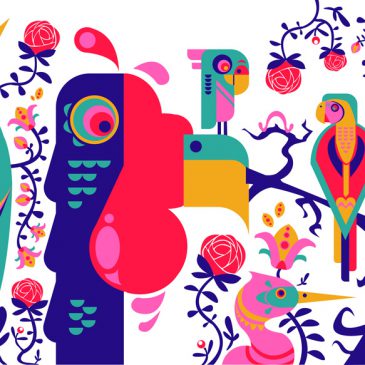
What does this make you think of?

>Joseph’s Coat of Many Colors
>Grandma’s Quilt
>Symbolic of Order & Chaos

Posted in Ideas, Uncategorized | Leave a comment

Designing for Difficult Surfaces

By: Chris Burnett
Chair, Department of Art, The Center for the Visual Arts, University of Toledo, OH

How do you print a two-dimensional graphic on a three- dimensional surface, or even figure out how to design the graphic in the first place with all the growing options of screens and mobile devices? Students in the University of Toledo’s new BA degree in New Media Design Practices (NMDP) will be doing just that. In planning this new program we aimed to create a unique balance between a broad view of art with specific practical experiences in the design field. The curriculum accomplishes this balance with a wide assortment of studio and liberal arts courses peppered with internships and externships that will give students real world experience with the design activities of area arts organizations and institutions. The program will weave together classroom-based skills with practical experience in producing materials for a museum exhibition for example. In beginning this program, we are especially keen on looking outside the studio at what student designers actually do with their graphical works: where do their designs go, what shape do they take, even what surfaces they might occupy.

Given the wide range of design practices in the world together, it was important that the emphasis on new media productions tools would expand rather than limit the options for output and product. Clearly the design world today consists of a crazy quilt of print and paper graphics folded, cut, and rolled in a wild assortment of formats. Alongside these textured and glossy surfaces, there exist the electronic screens that are growing and shrinking to become almost as pliable as their paper-based cousins. We felt strongly in creating this program that the NMDP student needs to navigate easily between these graphical spaces and surfaces. Moreover, the student designer should not only be able to switch-hit – to design a print piece for one project; an interactive screen-based design for another – but to germinate hybrid forms where their design-creatures can easily creep from the fixed-form of print to the fluid windows of screen-space. Of course, these imperatives, to design more flexibly and adaptably, have gelled into important principles and specific systems of the design process today, such as CSS in web page design, where the designer deliberately separates content and information structure from the application of style. Even with these well-worked-out principles, there remain slippery questions about how a designer proceeds in face of the mutable surfaces emerging in the world today. What do we call these surfaces that elude categories of either print or screen?

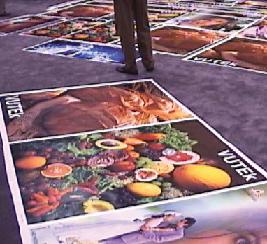
To suggest an answer, we would like to explore a prominent trade show of the Specialty Graphic Imaging Association (SGIA). There, you will find every kind of decorated, adorned, printed, inscribed, patterned, and stenciled surface imaginable. There are T-shirts, ball caps, posters, envelopes, and stamps, just to mention a few of the forms. All these specimens are hung in the air on wires, lying on the ground, applied to walls, and stacked in corners. Accompanying these graphic products are the very machines and printers that would create them. They, too, are adorned in colors and designed but in a low-key functional manner. On the other side of the gap between production and consumption are the accoutrements of distribution: the folders, mailing tubes, and polyethylene bags that send all these graphics into orbit – seemingly out of this world. “Where do they come from and where do they go?” one wonders while walking from one booth to another in this vast trade-show pavilion.

One booth in particular, offered a ray of hope — that particular term that might sum up the proliferation of output options in graphic production. “Difficult surfaces” is a term the trade uses for surfaces that are simply difficult to print on. In practical terms, these include objects that because of their dimension or surface-quality cannot receive ink, pigments or markings with the traditional printing processes of letterpress, engraving or screen-printing. Often their curves, rounded, or excessively intricate shape prohibit the ready surface-to-surface contact of normal printing processes. Their very dimension and spatial twists make them difficult: a challenge for the printing and graphic design professions.

Of course, the flooding of our world with these difficult surfaces would certainly give vivid testimony that design professionals have met the challenge. Examples of these objects are bottle caps, ink pens, basketballs, coffee cups, bowls, tennis rackets, beer cans, cup insulators, lampshades, pencils, and a galaxy of other such objects. Even though these things may pose a challenge, they scream at us that no human substance or artifact today may escape graphic culture: everything is positioned for the marking. Difficult surfaces don’t so much speak to the difficulty but, conversely, to the ease and ubiquity of signs in forming material culture. And, they serve as a metaphor for the still difficult-to-grasp combinations of conventional and electronic surfaces that are emerging in communications today.

To come back to the New Media Design Practices program, we are looking at ways to take advantage of the kaleidoscopic range of surface effects and material options open to designers in practical terms. Following the metaphor of “difficult surfaces,” designers have to make designs not only look a certain way in fixed terms of shape, color, pattern, and so on. But they must also consider how allow them to change shape according to the difficult surfaces that they might occupy. Like hairstyles, the graphics are designed to be flipped, air blown, turned upside down, and, somehow, to fall back into place. Like objects in the real world, they must scale up to occupy the sides of buildings or shrink down to the head of a pin. And, like one of Salvador Dali’s dripping clocks, they can be hung out to dry and then ironed out flat, stiff as a starched shirt.

By paying attention to the variety of difficult surfaces in the physical world, we are hoping that the NMDP program can inspire students to approach other levels of variability in electronic media. The first action in forming the bridge is to understand how closely electronic images still cling to surfaces. Their “difficulty” has merely shifted from tangible texture and volume to the properties of particles. It will be an exciting process for our new program to investigate the design properties of these electronic surfaces in all the forms they are taking: from large-format LED screens to the hand-held screens of mobile technologies. One lesson that we will always hold in mind is that these emerging formats are surfaces nonetheless, difficult surfaces that expand the possibilities of graphic communication. ■

Posted in Ideas | Leave a comment

Finals Week – A typical expression found on campus

Silly…yes…but I do enjoy water colors.

Posted in Ideas, Uncategorized | Leave a comment

Monica Kullar: Cover Contest Winner!

Monica KullarMonica Kullar, a senior at Evergreen Valley High School in San Jose, Calif., has taken art and photography classes at school, but treasures the time she is on her own, creating. Writer Oscar Wilde once said, “Art is the most intense mode of individualism that the world has known.” For Monica, art is very personal and extremely individual.

“My art is on my own time, often on the weekends. I buy canvases and fill up sketch books,” she says. “It differs on where I am when I paint. I live near some great hills so sometimes friends and I will head to the hills and paint together. I really like to paint everything … intricate designs, shapes, whatever is on my mind.”

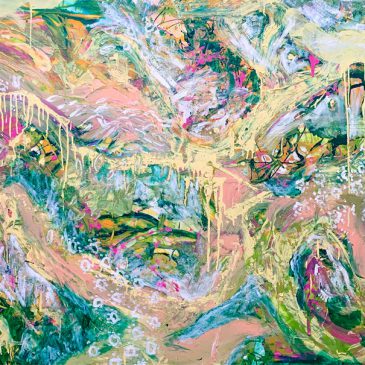
Her painting, Exposed, uses bright reds and blues mixed with soft tans and whites to express how Monica sees the human body and what s underneath. The painting is acrylics on canvas. “Just last summer, in the middle of the night, I was looking in the mirror and thinking about how the human body really comes in shades of brown, tan and white, but I thought about painting the colors of the veins and arteries and bringing the inside on the outside.”

Monica says sometimes her paintings are projects she works on over a couple of months, but other works are projects created during one sitting. “Exposed was the result of a summer night. I really am more inspired during the free time.”

Creative Outlook Magazine Cover 2011Most of her sketchbooks are filled with ink pen, pencil and some charcoal sketches. For her canvases, she uses mainly acrylics. “I feel most proud of the work I submitted to the Creative Outlook contest. I conveyed what I thought of and it hit home. I am working on a colorful face full of abstract shapes.”

Monica also finds inspiration from two seemingly unlikely artists. The first is the graffiti artist Blu. He also has created some stop-motion animation. The second is artist Leonid Afremov.

“A friend showed me one of his paintings. It was of two people walking under an umbrella. They are illuminated by lamplight on this walkway. It’s so amazing how he shows the rain and the lights and all the colors, even though it is clearly night in the painting. He inspired me to use colors. His works really stand out to me.”

During her school days, she is busy with Advanced Placement classes such as calculus, English literature and statistics. She also participates in environmental clubs and has been known to help plant trees and clean up litter. Monica also helps with the Stanford Blood Center bloodmobiles. Her other art includes playing the violin since fifth grade.

Monica hopes her talents continue to develop. She wants to pursue a career that helps others. “I don’t know if art will be my profession, but I can see art being a major part of my life. I see art as something I do outside of school in the freedom of my own time and thoughts. If my artwork continues to improve and I can make use of opportunities, it would be a dream to have a gallery to showcase it all. It’s just that for me, I do my art best when I’m free to do whatever inspires me and whatever’s on my mind rather than with the limits of an art project assigned to me in a classroom. I am definitely planning on continuing painting and sketching for the rest of my life, and I’d love for people to feel something when seeing my artwork. I am most proud of my most recent paintings so I feel that one day I will have a good set of paintings I’d want exposed. Until then, I’m going to keep painting and painting!”

Exposed

Posted in Cover Contest, Ideas | Leave a comment

Hopeless

Ambar, who attends Cape Coral High School submitted this for the Creative Outlook Cover Contest… I love the composition and use of color in the shadows.

Posted in Cover Contest, Ideas | Leave a comment